
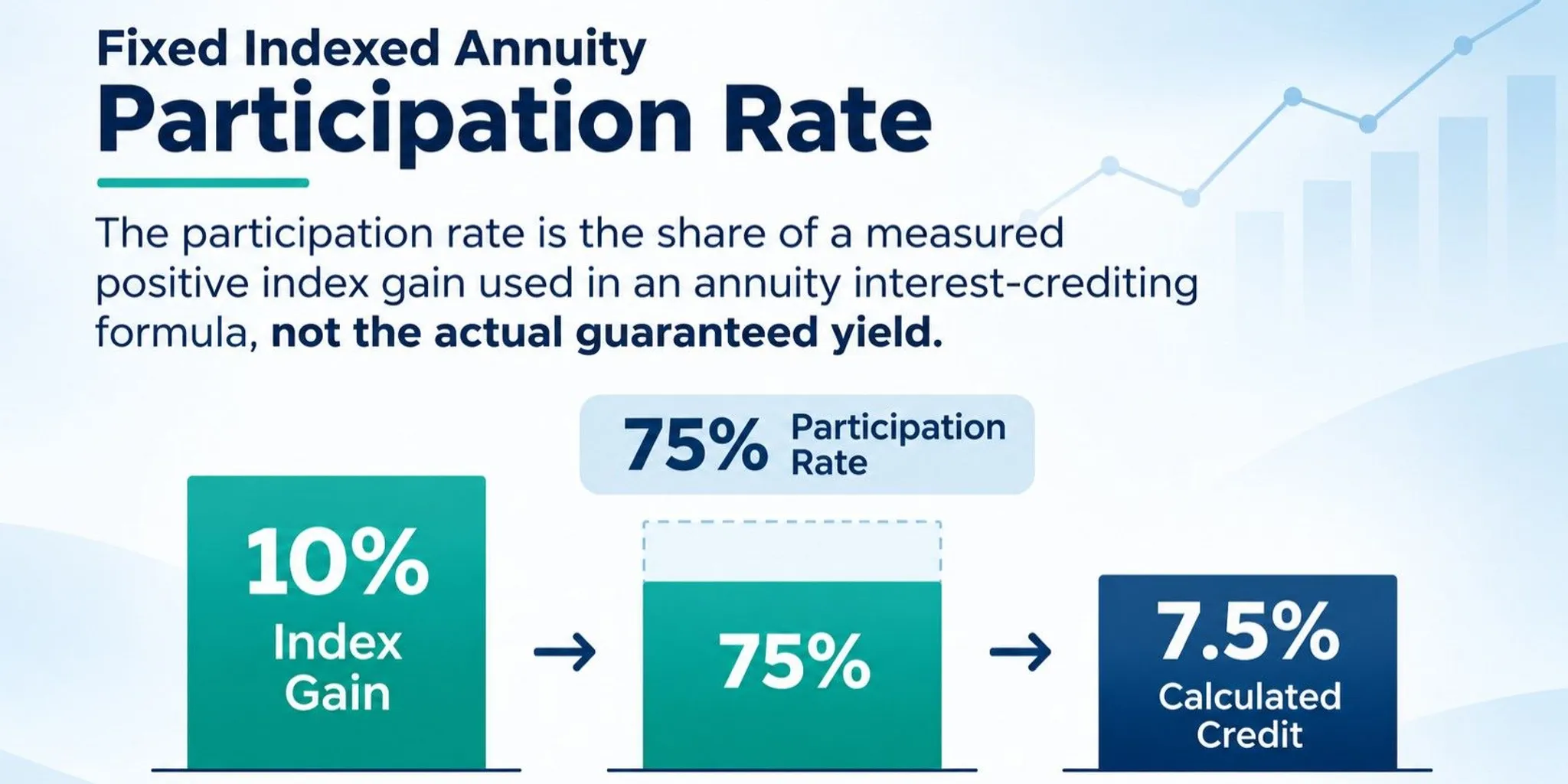
A fixed indexed annuity participation rate is the share of one measured index gain that the contract uses in its interest formula. It is not the rate you earn.
Join the free live annuity education webinar, held online on Tuesday at 2:00 PM ET. The session covers various fixed indexed annuity strategies, riders, and options so you can compare considerations. Nothing is sold during the presentation, and no specific product is recommended. Any later conversation is optional.
The rate is one term in a larger crediting formula. It sits beside the broader fixed annuity trade-offs, and the site's overview of fixed indexed annuities names it next to a cap and a spread. This article stays on the participation rate itself: how a contract applies it, what the number does not promise, and which questions to ask before you compare two offers. Examples below are teaching math from a public investor bulletin. They are not a quote, a forecast, or a result for any contract.
- Key takeaway: The participation rate is a share of one measured index gain, not a stated yield on the whole contract.
- Key takeaway: A higher rate is not automatically better. The index, period, cap, spread, and renewal rules all change the result.
- Key takeaway: The insurer can often change the rate at renewal. Read the contract for any minimum and for how long the current rate lasts.
What does a fixed indexed annuity participation rate mean?
In a fixed indexed annuity, you do not buy shares of the index. You own an insurance contract. The insurer credits interest using a formula tied to a change in that index over a stated period. The participation rate is the percentage of a positive index change that the formula counts.
The U.S. Securities and Exchange Commission staff explained this in its Updated Investor Bulletin: Indexed Annuities (July 31, 2020). In the bulletin's example, a 75% participation rate applied to a 10% calculated index return produces a 7.5% credit (10% times 75%). That example shows the arithmetic. It does not describe a contract you can buy today.
Read the rate together with the rest of the formula. A contract may also use a cap, a spread, a floor, or another limit, and it names the order in which those terms apply. The same measured index change can produce different credits under different formulas. The rate alone does not tell you what will be credited.
Also notice what the index change usually leaves out. The SEC bulletin says gains are generally calculated without the dividends paid by the securities in the index. A published total return and the change your contract measures can differ before the participation rate is applied at all.
How might the rate be applied to one index period?
A typical teaching sequence has four steps. Your contract may add, skip, or reorder steps. Follow the contract, not this list.
- Identify the index and the start and end of the measurement period named in the contract.
- Calculate the index change using the contract's method, such as point-to-point or averaging. Dividends are often excluded.
- If the change is positive, multiply it by the participation rate that applies to that strategy and period.
- Apply any cap, spread, floor, or other limit in the order the contract specifies, then credit the result under the contract's terms.
Using only the SEC bulletin's participation-rate example, a calculated index gain of 10% and a 75% rate produces 7.5%. If the calculated gain were 4%, the same rate would produce 3%. If the calculated change were zero or negative, there is often no positive amount for the rate to share. Many fixed indexed annuity formulas credit zero indexed interest for that period rather than a negative index credit. That is a feature of the formula, not a promise that your contract value cannot fall for other reasons.
The bulletin also shows features used together. A 75% participation rate and a 3% spread, applied to a 10% calculated index return, produce 4.5%: 10% times 75% is 7.5%, and 7.5% minus 3% is 4.5%. A cap can cut the result further. Our article on the annuity cap rate explains that ceiling. Do not treat a participation-rate example as the amount you will receive.
Participation rate.
- What it does to one measured index gain.
- Uses a stated share of the calculated gain.
- SEC bulletin teaching example.
- 75% of a 10% gain credits 7.5%.
Cap.
- What it does to one measured index gain.
- Stops the credited result at a stated maximum.
- SEC bulletin teaching example.
- A 7% cap on a 12% gain credits 7%.
Spread, margin, or asset fee.
- What it does to one measured index gain.
- Subtracts a stated amount from the calculated gain.
- SEC bulletin teaching example.
- A 3% spread on a 9% gain credits 6%.
Rate plus spread.
- What it does to one measured index gain.
- Applies the share, then subtracts the spread.
- SEC bulletin teaching example.
- 75% of 10%, minus a 3% spread, credits 4.5%.
| Term in the formula. | What it does to one measured index gain. | SEC bulletin teaching example. |
|---|---|---|
| Participation rate. | Uses a stated share of the calculated gain. | 75% of a 10% gain credits 7.5%. |
| Cap. | Stops the credited result at a stated maximum. | A 7% cap on a 12% gain credits 7%. |
| Spread, margin, or asset fee. | Subtracts a stated amount from the calculated gain. | A 3% spread on a 9% gain credits 6%. |
| Rate plus spread. | Applies the share, then subtracts the spread. | 75% of 10%, minus a 3% spread, credits 4.5%. |
These rows restate examples from the July 31, 2020 SEC staff bulletin. They are not current offers, and a contract may combine the terms in a different order. FINRA's July 14, 2022 investor insight, The Complicated Risks and Rewards of Indexed Annuities, makes a related point: features of an indexed annuity may produce a lower return than an investor expects.
How is a participation rate different from a cap or a spread?
All three terms can reduce the credit below the raw index change. They do it in different ways.
A participation rate scales the gain. At 80%, the formula starts with four-fifths of the calculated increase. At 100%, this step does not reduce the gain by itself, but a cap or a spread still might. A rate above 100% can appear in some formulas. It still is not a promise of that return, because the index, the period, and any other limit still apply. Never treat a rate over 100% as proof that the contract will beat the index.
A cap is a ceiling. Once the formula reaches the cap, a larger index gain does not raise that period's indexed credit. A spread subtracts a set amount. The SEC bulletin also calls this a margin, an asset fee, or an administrative fee. It warns that these features can reduce your return the way a direct fee would, even on an annuity described as having no fee.
That warning is why the rate is not a fee schedule. Separate charges, such as rider charges or surrender charges, are a different question. The article on fixed index annuity fees covers those charges. Use this page for the share of the index gain, and that page for what the contract charges.
Why can the rate change at renewal?
The participation rate printed in a brochure is often the rate for an initial period, not a rate locked for the life of the contract. The SEC bulletin says indexed annuity contracts commonly allow the insurance company to change some features periodically, such as the rate cap, and that those changes can affect your return.
Ask which participation rate is guaranteed, if any, and which rate the insurer may declare again at the end of the term. A contract may set a minimum participation rate and still leave room to declare a lower rate than the one in force today, down to that minimum. An illustration that assumes today's rate continues can overstate later credits.
Renewal also interacts with the index strategy you picked. A contract may offer more than one strategy, each with its own index, period, participation rate, cap, or spread. Renewing into a different strategy is not the same decision as accepting a new rate on the strategy you already hold. Read both the renewal notice and the strategy description.
What else should you compare besides the rate?
Two contracts can show the same participation rate and still credit different interest. Compare the pieces that sit around the rate before you compare the rate itself.
- Index. Many contracts use a broad market index. Others use a narrower or volatility-controlled index. The index description and the annuity formula are separate layers.
- Dividends. If the measured change excludes dividends, the contract is not tracking the index's total return.
- Measurement method and period. Point-to-point and averaging can turn the same index path into different changes. Periods are often one year, but the contract controls the length.
- Other formula limits. A cap or a spread can matter more than a small difference in the participation rate.
- Floor on negative index changes. A formula that does not credit a negative index change is not the same as a guarantee against every loss of contract value.
- Charges and access. Rider charges, free-withdrawal limits, and surrender terms can reduce what you can take out even when indexed interest is credited.
If you want a stated interest rate for a set number of years instead of an index formula, that is a different product design. A multi-year guaranteed annuity credits a declared rate rather than a share of an index gain. That choice belongs with the broader fixed-annuity comparison, not with the participation-rate math on this page.
How do you compare two participation-rate offers?
Line the offers up on the same facts. A higher rate on a different index, a different period, or a tighter cap is not a better offer. It is a different formula.
For each offer, write down the index and whether dividends are included. Add the crediting method, the length of the period, and the current participation rate. Note any minimum rate, cap, spread, and the date those terms can change. Then read the withdrawal and surrender terms beside them. An illustration is useful only if you can see which of those inputs it assumed.
Ask the person presenting the offer to show the calculation for one up period and one flat or down period, using that contract's order of operations. If the illustration cannot be tied back to the contract, do not use the illustration as the comparison.
The Annuity Finder, powered by The Institute of Financial Wellness, publishes this explanation so you can take those questions to a qualified professional. It is not an insurer, and it does not recommend a participation rate, a carrier, or a product on this page.
What limits should you keep in view?
You can lose money in an indexed annuity. The SEC bulletin lists several ways, including withdrawals before a measurement period ends and surrender charges, which often apply for six to ten years or longer. Taking money out early can mean you do not receive that period's indexed credit, and a surrender charge reduces the amount you receive.
Any contractual protection against a negative index credit depends on the contract and on the issuing insurer's claims-paying ability. It is not a government guarantee, and it is not the same as holding the stocks in the index. Taxes can also change what you keep. Indexed interest inside the contract is generally tax-deferred, not tax-free. This article does not cover the tax rules. Ask a qualified tax professional about your own situation.
Registered index-linked annuities and variable annuities use different structures, including buffers or investment accounts. They are outside the scope of this explanation. If a presentation mixes those products with a fixed indexed annuity participation rate, ask which contract you are actually reviewing.
Surrender rules deserve their own reading before you move money you already hold. The page on fixed indexed annuity surrender charges and withdrawal rules is the place for that question.
What questions can you take to a contract review?
Bring the contract or the illustration, not just the participation rate from a headline. These questions keep the review on the formula:
- Which index is measured, and does the change include dividends?
- What is the current participation rate, how long does it last, and what minimum can the insurer declare later?
- Does a cap or a spread apply in the same strategy, and in what order?
- What is credited if the measured index change is zero or negative?
- Which value does the rate apply to: an indexed strategy segment, a benefit base, or the whole contract?
- What can I withdraw without a charge, and what happens if I take money before the period ends?
- Which guarantees depend on the insurer's claims-paying ability?
A short educational quiz can help you sort those questions before a conversation. The Annuity Finder quiz leads to a Personalized Annuity Match Report. It does not decide what is best for you, and it is not a Retirement Security Report. That later report, when it is part of an optional expert conversation, is a separate step.
Register for the free live webinar if you want to hear how fixed indexed annuity strategies, riders, and options are compared. It is live online on Tuesday at 2:00 PM ET. Nothing is sold during the presentation, no specific product is recommended, and a later one-on-one conversation is optional.
Frequently asked questions
Is a higher fixed indexed annuity participation rate always better?
No. A higher rate uses a larger share of one measured index gain, but the index, the period, any cap or spread, and the renewal rules can matter more. Compare the whole formula, not the rate by itself.
Does a 100% participation rate mean I earn the index return?
No. A 100% rate means this step does not reduce the calculated gain. Dividends may still be excluded, and a cap, spread, charge, or withdrawal rule can still reduce what is credited or what you can take out.
Can the participation rate change after I buy?
Often yes. Many contracts set the current rate for one period and allow the insurer to declare a new rate later, sometimes subject to a minimum in the contract. Ask how long today's rate lasts and what the minimum is.
Is the participation rate a fee?
It is a crediting term, not a separate charge. The SEC staff notes that a participation rate, cap, or spread can still reduce your return the way a fee would, including on a contract marketed as having no fee. Rider charges and surrender charges are separate and should be listed on their own.
What if the index goes down?
The participation rate applies to a positive measured change. If the measured change is not positive, many fixed indexed annuity formulas credit no indexed interest for that period. That does not insure every dollar of contract value against surrender charges, rider charges, taxes, or the insurer's failure to pay.
Important information
This article is provided for general educational purposes and is not individualized financial, investment, tax, or legal advice. Annuity and insurance product features, availability, and guarantees vary by product, carrier, and state. Guarantees are subject to the claims-paying ability of the issuing insurance company. The Institute of Financial Wellness, LLC and/or affiliated insurance professionals may receive compensation in connection with insurance or annuity transactions. Examples are taken from the SEC staff's July 31, 2020 Investor Bulletin and are not offers or predictions.
Go deeper in the Knowledge Hub
Educational guides that expand on the topics covered in this article.
See What a Personalized Income Plan Looks Like
Answer a few questions and connect with an IFW Certified Retirement Income Expert to review your options.
Find My Income Plan